


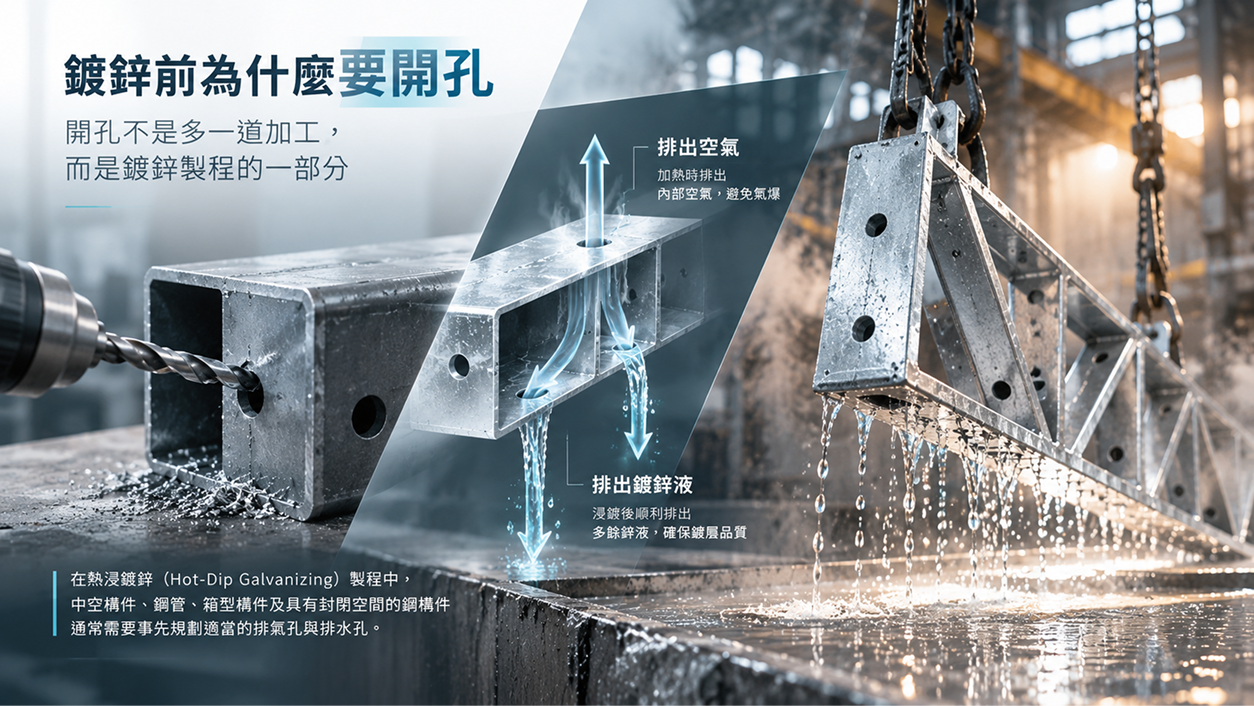
Holes are not an extra fabrication step,
they are part of the galvanizing process
In the Hot-Dip Galvanizing process, hollow components, steel pipes, box components and steel members with enclosed spaces usually need suitable vent and drain holes planned in advance.
This is because hot-dip galvanizing is not just about the workpiece surface "touching molten zinc." Before entering the kettle, the workpiece goes through several pre-treatment steps; when it enters each bath, the air inside, the treatment solutions and later the molten zinc all need clear paths in and out.
If enclosed spaces form inside the structure, air and liquids cannot escape normally. This may not only affect treatment and coating formation on internal surfaces, but also increase safety risks during hot-dip galvanizing.
Simply put: holes are made before galvanizing so that "gas can get out and liquids can flow in and out."
Proper vent and drain holes help pre-treatment solutions and molten zinc enter the spaces that need treatment, while letting air, bath solutions and excess zinc drain out smoothly. For hollow or enclosed components, this is directly related toprocess safety, galvanizing completeness, drainage efficiency and finished quality.
4 Reasons Holes Are Needed Before Hot-Dip Galvanizing
Vent and drain holes are not simply for convenience; they are linked to the entire pre-treatment, dipping and withdrawal process.
Letting gas escape from enclosed spaces
Without proper vent paths, the air inside hollow or enclosed components may not be able to escape as the workpiece enters the bath.
Especially in high-temperature hot-dip galvanizing, enclosed spaces and residual liquids can create process safety risks, so proper vent design is very important.
Letting pre-treatment solutions flow in and out
Hot-dip galvanizing requires surface pre-treatment beforehand. If the workpiece has a hollow structure, treatment solutions need to enter those spaces and drain out smoothly when the workpiece leaves each tank.
Proper hole positions help reduce internal liquid accumulation and allow different treatment steps to follow on smoothly.
Helping molten zinc flow in and out
If the internal surfaces of hollow components are to be hot-dip galvanized, molten zinc must be able to enter those spaces while the displaced air escapes.
When the workpiece is withdrawn from the kettle, proper drain holes also help excess zinc flow back, reducing zinc retained inside the component.
Supporting complete surface treatment and coating formation
Only when gas, pre-treatment solutions and molten zinc can flow freely can the steel surfaces that need treatment fully contact the baths. If air pockets form inside or liquids cannot flow freely, local surface treatment and subsequent coating formation may be affected.
Which steel components need
special attention to holes before galvanizing?
Not every workpiece sent for galvanizing needs extra holes drilled. Whether holes are needed depends mainly on whether the workpiece structure forms hollow, semi-enclosed or fully enclosed spaces, and whether baths and molten zinc can flow in and out normally.
For components welded from round tubes, square tubes or other hollow steel sections, check whether enclosed spaces form inside the tubes.
For box structures formed by welding steel plates, if the interior is fully enclosed, the venting and drainage method should be confirmed before galvanizing.
When two or more steel pieces are welded together and form a cavity with no connection to the outside, special attention is needed.
Even if a component appears open from the outside, internal diaphragms may still form several separate spaces, and each space needs to be checked for a flow path.
What is the difference between vent holes and drain holes?
The two work together. One lets air and gas escape, while the other lets pre-treatment solutions and molten zinc flow in and out smoothly, forming an effective flow path.
Vent Holes
Mainly allows air and gas inside the component to escape when immersed in the bath, preventing trapped air pockets or enclosed spaces.
The actual position should be planned according to the dipping direction and component shape.
Drain Holes
Mainly allows pre-treatment solutions, rinse water and molten zinc to enter and drain, helping excess liquid flow back as the workpiece is withdrawn from the tank.
Whether drainage is smooth is also affected by hole position, workpiece angle and internal structure.
The core concept of holes:
don't let gas and liquids get trapped
5 Key Points of Galvanizing Hole Design
Workpieces differ in size, structure and hanging method, so actual hole positions and diameters can't be determined by a fixed formula alone. However, the following basic principles can be applied in design.
Identify all enclosed spaces
Don't just look at the workpiece's exterior; also check whether internal cavities form after welding. If the component has diaphragms, confirm that each separate space has venting and drainage paths.
Match the actual dipping direction
Workpieces usually enter and leave the bath at a suitable angle. Vent and drain positions should be planned to match the actual dipping direction so that air can escape at the high points while baths and molten zinc enter and drain at suitable locations.
Vent and drain paths must work together
A single hole may not solve both venting and drainage. Based on the internal space and dipping direction, gas and liquid should each have a smooth flow path to avoid air pockets or liquid traps.
Holes must not be blocked by welds or other parts
Even if holes are shown on the design drawings, if they are covered by welds, stiffener plates, connectors or other parts after assembly, they may lose their intended venting and drainage function. They must therefore be re-checked on the completed component as a whole.
Hole size should be confirmed for each workpiece
Vent and drain holes aren't just a matter of "having one." If holes are too small, they may restrict the flow of gas, pre-treatment solutions or molten zinc. Actual hole diameters and numbers should be confirmed based on component size, internal volume, structural form and actual galvanizing conditions.
No single set of vent and drain hole sizes fits every workpiece
Steel components differ in size, internal volume, welding method, diaphragm layout and actual dipping direction, so a single fixed hole diameter cannot simply be applied to all hot-dip galvanized workpieces.
If the workpiece has hollow, box-section or complex enclosed structures, we recommendconfirming subsequent hot-dip galvanizing requirements at the design and fabrication stage, and checking before galvanizing whether vent holes, drain holes and hanging methods suit the actual process.
5 Common Problems with Galvanizing Holes
Many hole problems are not a complete lack of holes, but a failure to consider hole positions, flow direction and internal structure together.
Only drain holes, no thought given to venting
When liquid enters a hollow space, the air originally inside also needs a way out. Considering only liquid drainage and ignoring venting can still form air pockets.
Holes are present, but in the wrong place
If hole positions don't match the actual dipping angle and the component's high and low points, air may still fail to escape or liquid may remain.
Ignoring internal diaphragms
A component that appears connected from the outside may form several separate cavities due to internal stiffeners or diaphragms. Each space needs its flow path re-checked.
Holes too small
Holes that are too small may restrict the flow of air, baths and molten zinc, so it's not enough to confirm whether there are holes; the size must also suit the actual workpiece.
Thinking about galvanizing
only after all welding is done
If hot-dip galvanizing isn't considered at the design stage and holes are only dealt with after all welding is complete, modifications and fabrication may become more difficult. If the product is confirmed to need hot-dip galvanizing, it's best to incorporate venting, drainage and hanging requirements at the design and drafting stage.
Before galvanizing hollow components,
we recommend confirming 6 things
Check whether sealed cavities form inside steel pipes, boxes and welded structures.
Confirm that internal air can escape smoothly when immersed in the bath.
Confirm that pre-treatment solutions and molten zinc can flow in and out of the component smoothly.
Confirm that every space separated by a diaphragm has a suitable flow path.
Confirm based on component size, structure and actual dipping direction.
Hole positions should match how the workpiece is actually hung, enters and leaves the bath.
The best time to plan holes
is at the design stage.
If a steel component is confirmed to need hot-dip galvanizing, we recommend considering vent holes, drain holes and hanging methodsbefore design, drafting and welding .
Compared with re-drilling or modifying the structure after the workpiece is fully fabricated, confirming galvanizing requirements early makes it easier to arrange hole positions, welding methods and overall component design, and reduces the need to modify workpieces later to meet process requirements.
So, why drill holes before galvanizing?
Because for hollow or enclosed steel components, hot-dip galvanizing needs more than just "letting zinc touch the surface" — it needsair, pre-treatment solutions and molten zinc to flow in and out of the component smoothly according to the process.
Proper vent and drain holes help reduce the process safety risks caused by enclosed spaces and make surface pre-treatment, zinc flow and workpiece drainage smoother. Holes should therefore be treated as an important design condition before hot-dip galvanizing, not a fabrication step added at the end.
Hot-Dip Galvanizing Holes FAQ
Q1. Why must vent holes be considered before hot-dip galvanizing?
For steel components that are hollow or have enclosed spaces, the air originally inside needs a smooth way out when the workpiece is immersed in pre-treatment tanks or the zinc kettle. If air is trapped inside the component, air pockets may form and prevent the bath from entering, which can also increase safety risks in the high-temperature galvanizing process.
Q2. What happens if no holes are made before galvanizing?
If hollow or enclosed components lack proper venting and drainage paths, air may not escape, pre-treatment solutions may not fully enter, liquid may collect inside or zinc may not flow properly. For completely enclosed spaces that may contain residual liquid, safety risks during hot-dip galvanizing may also increase.
Q3. Do hollow steel pipes need holes for hot-dip galvanizing?
If steel pipes or hollow components form enclosed or semi-enclosed spaces after welding, you need to confirm whether they have proper venting and drainage paths. Whether additional holes are needed, and their position and size, should be confirmed based on the component structure, end details and actual dipping method.
Q4. Can the same hole serve as both a vent hole and a drain hole?
Whether one opening can serve both functions depends on the workpiece shape, internal space and actual dipping direction. The key isn't what the hole is called, but whether gas and liquid both have smooth and sufficient flow paths as the workpiece enters and leaves the bath.
Q5. How large should vent holes be for hot-dip galvanizing?
No single hole diameter can be applied to all steel components. The required diameter and number of holes are affected by component size, internal volume, structural form, diaphragm layout and actual dipping direction. For large or complex components, we recommend confirming before fabrication based on actual galvanizing conditions.
Q6. Are more holes always better?
No. Holes must balance venting and drainage functions with the component's own design. The key is proper position, size and number so that gas and liquid can flow smoothly, not simply adding more holes. For structural uses, confirm according to the original design and engineering requirements.
Q7. Can holes still be added to a fully welded steel component before galvanizing?
Whether post-fabrication is possible must be confirmed based on the actual component structure and engineering requirements. If the workpiece has already been welded, we recommend checking for internal enclosed spaces before galvanizing and confirming whether the new hole positions will affect the original structure and usage requirements. Ideally, galvanizing requirements should be incorporated at the design and fabrication stage.
Q8. If only the exterior needs galvanizing, do internal spaces still need holes?
Even if the product design is mainly concerned with the external surface, as long as a completely enclosed space forms inside the component, venting still needs to be addressed from the standpoint of galvanizing process safety. So whether holes are needed cannot be judged simply by whether the interior requires a coating.
Q9. What if I don't know where to put the holes before galvanizing?
For more complex components, we recommend providing engineering drawings, component dimensions and internal structure information before formal fabrication or galvanizing, and confirming the intended hot-dip galvanizing method. K.C.F. can help confirm the venting, drainage and related fabrication conditions that need attention before galvanizing, based on the actual workpiece and process requirements.
Consider galvanizing first,
then complete the component design.
For general open steel components, venting and drainage are usually not a major issue; but whenever a product uses steel pipes, box structures, diaphragms or enclosed welded designs, you should further check whether sealed spaces form.
Incorporating vent holes, drain holes, hanging and dipping direction into the design in advance not only makes the hot-dip galvanizing process smoother, but also reduces the chance of having to modify the structure after the product is finished.