


Does a brighter coating
mean better quality?
The answer is:not necessarily. After Hot-Dip Galvanizing, the surface may appear bright silver, matte gray, dark gray or show local variations in color. These differences in appearance are related to how the coating forms.
Hot-dip galvanizing is not simply "painting a layer of zinc" on the steel surface. When steel is immersed in molten zinc, the zinc reacts with the steel surface to form zinc-iron alloy layers and an outer zinc layer.
The steel's chemical composition, material condition, thickness, surface condition and the actual galvanizing process can all affect the coating reaction and final appearance. Therefore,"how bright it is" cannot be used as the standard for judging hot-dip galvanizing quality.
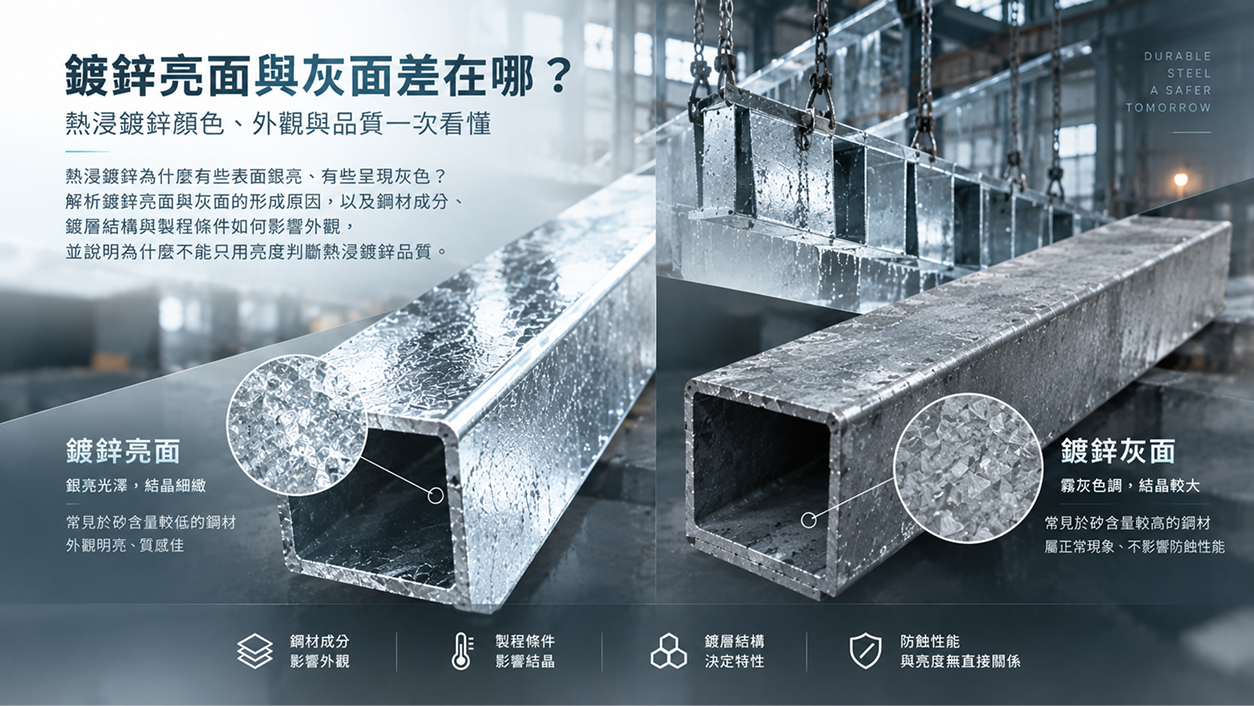
Bright and gray finishes mainly reflect differences in coating appearance and surface structure.
In general, bright surfaces usually have a more distinct outer zinc layer, while some gray coatings may be related to a more pronounced zinc-iron reaction, with the alloy layers extending close to the surface. Neither appearance can be directly equated with "good" or "bad"; whether quality requirements are met should still be judged bycoating thickness, coverage, adhesion and the applicable standards.
What Is the Difference Between Bright and Gray Galvanized Finishes?
The most visible differences are color and luster, but what actually causes the different appearance is related to the degree of reaction between the steel and molten zinc and the coating structure.
Bright Coating
Usually appears distinctly silvery white with a metallic luster, showing a brighter zinc layer on the surface.
Bright silver with a more pronounced metallic luster, visually closer to what most people expect "new galvanizing" to look like.
Gray Coating
May appear matte gray, grayish white or darker gray, with a surface luster usually less pronounced than a bright coating.
Anything from matte gray to dark gray may occur; in some cases this relates to the zinc-iron alloy layers being more visible at the surface.
Why can the same batch of galvanized workpieces
have both bright and gray finishes?
The surface appearance of hot-dip galvanizing is influenced by many conditions together. Even if workpieces go through the same process, differences in steel, thickness or local fabrication can still produce differences in appearance.
Different steel chemical composition
The chemical composition of the steel affects the degree of reaction between zinc and iron. Even steels that look similar may have different coating growth and surface color after hot-dip galvanizing if their compositions differ.
Steel from different sources in the same component
If a single steel product is welded from steel of different batches, sources or material conditions, each part may react with molten zinc to a different degree, so bright and gray areas may appear on the same workpiece after hot-dip galvanizing.
Steel thickness & workpiece conditions
Steel of different thicknesses, sizes and structures may heat up, react and cool differently during hot-dip galvanizing. So even with the same galvanizing process, the final surface color may still vary.
Surface condition & fabrication differences
Before galvanizing, workpieces may undergo cutting, welding, grinding or other fabrication, which can create differences in surface condition between areas. These conditions may also affect subsequent pre-treatment and the zinc-iron reaction, causing different colors on the finished surface.
Galvanizing process & cooling conditions
Process conditions such as the actual reaction during dipping, workpiece size and cooling after withdrawal from the kettle can all affect the coating's final appearance. A hot-dip galvanized surface therefore won't necessarily have a completely uniform bright silver color.
So what should you actually look at
to judge hot-dip galvanizing quality?
Rather than looking only at color and luster, it is more important to confirm quality according to the product's applicable standards, engineering specifications and the acceptance criteria agreed by both parties.
Confirm coating thickness requirements according to product category, steel thickness and applicable standard.
Confirm that steel surfaces requiring galvanizing have complete coating coverage.
Confirm the bond between the coating and the steel substrate according to the applicable standard.
Check for zinc lumps and sharp protrusions that would affect handling, installation or use.
"Brighter" does not mean "thicker coating"
Surface luster is mainly an appearance feature and cannot be used to infer coating thickness. A bright silver workpiece does not necessarily have a thicker coating than a gray one; likewise, a gray surface does not necessarily mean a thinner coating or poorer quality.
If a project has specific coating thickness requirements, actual inspection should be carried out according to the applicable standard, rather than judging by the surface color with the naked eye.
A galvanized coating that was very bright
may become less bright later
Once a hot-dip galvanized workpiece is exposed to the environment, the zinc surface changes over time with its surroundings, so the bright silver appearance right after galvanizing will not remain exactly the same forever.
As reaction products gradually form on the surface, the appearance may become more matte or duller. "Reduced luster" in itself therefore cannot be equated with the coating having lost its protective function.
Bright vs. Gray Hot-Dip Galvanized Finishes FAQ
Q1. Why does hot-dip galvanizing turn gray?
A gray hot-dip galvanized surface may be related to the steel's chemical composition and the degree of zinc-iron reaction. When the zinc-iron alloy layers are more visible at the coating surface, the appearance may change from bright silver to matte gray or darker gray. The actual cause must still be judged together with material and process conditions.
Q2. Is gray galvanizing of poorer quality?
Not necessarily. Gray mainly describes the coating's appearance and cannot on its own determine quality. Whether requirements are met should be confirmed according to coating thickness, coverage, adhesion and the applicable standards.
Q3. Does a brighter galvanized coating mean a thicker coating?
No. Surface brightness mainly reflects coating appearance and cannot be used to infer actual coating thickness. If a project or product has coating thickness requirements, actual thickness inspection should be carried out according to the applicable hot-dip galvanizing standard, rather than relying on visual judgment.
Q4. Why is one workpiece half bright and half gray?
If a single workpiece combines steel of different batches, sources or material conditions, each part may react with molten zinc to a different degree. Steel thickness, welding and local fabrication can also cause differences, so different colors on the same workpiece do not necessarily mean local galvanizing failure.
Q5. Does a gray coating still protect against rust?
A gray appearance in itself does not mean the coating has lost its protective function. If the coating fully covers the steel surface and meets the thickness and quality requirements of the applicable standard, it still provides hot-dip galvanizing's corrosion protection. Actual quality should still be judged by inspection results.
Q6. Can all hot-dip galvanized workpieces be required to have a bright finish?
The surface appearance of hot-dip galvanizing is affected by factors such as steel chemical composition, material thickness, fabrication method and process conditions, so the final color of all workpieces cannot simply be treated as a fully controllable decorative finish. If a project has special requirements for appearance consistency, we recommend raising them before fabrication and galvanizing to confirm feasibility and acceptance criteria.
Q7. If a freshly galvanized bright finish later turns gray, is it rusting?
Not necessarily. Once exposed to the environment, the zinc surface changes over time with its surroundings, and an originally brighter appearance may gradually become matte or gray. Simply losing luster does not mean the steel has corroded.
Q8. Can a hot-dip galvanized surface with color variation pass acceptance?
Whether acceptance requirements are met should be judged according to the hot-dip galvanizing standard, engineering specifications and contract conditions specified for the project. If the color variation is only a bright/gray difference in appearance, the coating cannot be judged non-conforming on that basis alone; coating thickness, coverage and other specified inspection items must also be confirmed.
Q9. How do you tell whether a galvanized surface really has a problem or just a different color?
Start by distinguishing "appearance and color" from "coating quality." Bright finishes, gray finishes and local color variations are appearance observations; quality judgment should further confirm complete coverage, conformity with coating thickness requirements, and the absence of bare spots, unacceptable flaking or other conditions affecting use. If the project has a specified acceptance standard, that standard takes precedence.
When judging galvanizing quality,
don't just look at how bright it is.
Bright and gray hot-dip galvanized finishes mainly reflect differences in the coating appearance formed after steel reacts with molten zinc. Steel chemical composition, material source, thickness, fabrication and process conditions can all affect the final color and luster.
Therefore,a bright finish isn't necessarily better, and a gray finish doesn't mean poorer quality. True quality judgment should return to the coating thickness, coverage and adhesion required by the applicable standards and to actual service requirements.