


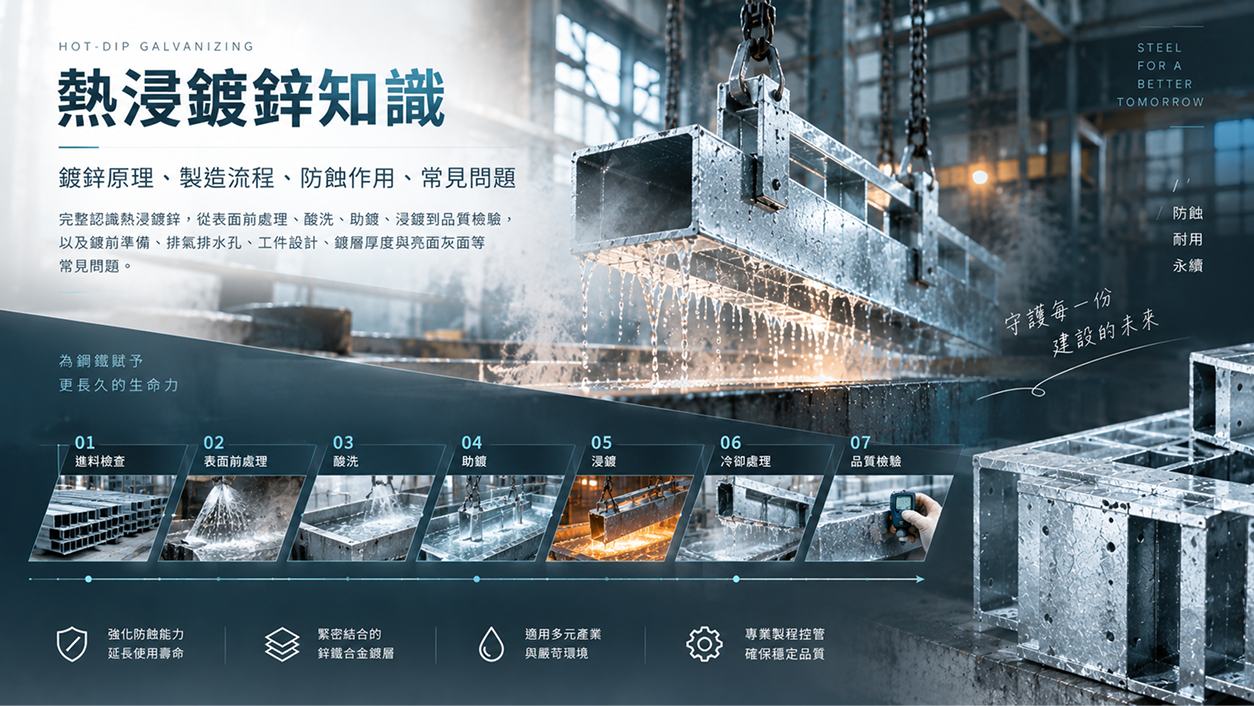
Hot-dip galvanizing is
more than "coating steel with zinc"
Hot-Dip Galvanizing is a corrosion protection treatment in which surface-pre-treated steel workpieces are immersed in molten zinc, causing the zinc to react with the steel surface and form a protective coating.
From the moment a workpiece enters the galvanizing plant, it goes through workpiece inspection, surface cleaning, pickling, rinsing, fluxing, drying, dipping, cooling and finishing, and quality confirmation. Every step is related to the final coating formation and product use.
The structure of the workpiece itself is also important. Especially for steel pipes, box components and enclosed welded structures, venting, drainage and hanging conditions should be considered at the design stage, rather than dealt with after the workpiece is finished.
Get to know hot-dip galvanizing from these 6 angles
How does hot-dip galvanizing help protect steel from corrosion?
The corrosion protection of hot-dip galvanizing is not a single mechanism; coating coverage and the material properties of zinc itself work together to reduce the chance of steel corrosion.
Barrier Protection
A complete coating covers the steel surface, forming a barrier between the steel and the external environment and reducing direct contact between the substrate and moisture or corrosive media.
Sacrificial Protection
Zinc has different electrochemical properties from steel, so under certain conditions zinc reacts preferentially, providing further corrosion protection for the steel substrate.
Hot-Dip Galvanizing Manufacturing Process
Hot-dip galvanizing is not a single "dip in zinc" step. From cleaning, pickling and fluxing the steel surface to entering the zinc kettle, cooling, finishing and quality inspection, every step affects the subsequent coating formation and finished product.
Incoming Inspection & Hanging
Workpiece dimensions, structure and surface condition are confirmed, vent holes, drain holes and hanging conditions are checked, and subsequent treatment is arranged according to the workpiece's characteristics.
surface pre-treatment
Necessary surface cleaning is carried out according to workpiece condition. Paint, stickers, some welding slag and other deposits that are difficult to remove with ordinary chemical pre-treatment should be properly dealt with before galvanizing.
Pickling & Rust Removal
Pickling removes rust and mill scale from the steel surface so that steel surfaces to be galvanized can go on to subsequent treatment.
Rinsing
Removes residual acid and impurities from the workpiece surface after pickling, reducing carry-over of the previous bath into subsequent treatment steps.
Fluxing & Drying
Fluxing reduces the chance of the clean steel surface re-oxidizing and prepares it for the subsequent reaction between steel and molten zinc. Before dipping, the workpiece must be brought to a suitable condition according to the process.
Hot-Dip Galvanizing
Pre-treated steel workpieces are immersed in molten zinc, where the zinc reacts with the steel surface to form zinc-iron alloy layers and an outer zinc layer.
Cooling & Finishing
After dipping, workpieces are cooled as required, and zinc lumps and sharp protrusions that may affect handling, installation or use are dressed.
Quality Inspection
Coating appearance, coverage, thickness and other specified inspection items are confirmed according to the product's applicable standards, engineering specifications and order requirements, before packaging and shipping are arranged.
Before galvanizing, we recommend confirming these 6 things
Confirm whether the length, width, height and overall structure meet subsequent processing conditions.
Confirm whether paint, stickers, welding slag and the like need to be removed beforehand.
Check whether steel pipes, boxes and welded structures form sealed cavities.
Give gas, pre-treatment solutions and molten zinc suitable paths in and out.
Confirm the workpiece has hanging positions suitable for subsequent process scheduling.
If standards, coating thickness or inspection documents are specified, raise them before processing.
Why does workpiece design affect hot-dip galvanizing?
Hot-dip galvanizing involves immersing the entire workpiece in different baths, so whether the workpiece can vent, fill and drain smoothly directly affects process safety and treatment results.
Vent Design
When hollow or enclosed components are immersed in a bath, the air originally inside needs a suitable way out. If air is trapped inside the component, air pockets may form and prevent baths and molten zinc from entering.
Drain Design
Pre-treatment solutions and molten zinc must be able to enter the component and drain out smoothly as the workpiece leaves the tank. Proper drain design helps reduce liquid accumulation and zinc retention inside the component.
After hot-dip galvanizing,
is the surface always bright silver?
Not necessarily. A hot-dip galvanized surface may appear bright silver, matte gray, dark gray or show local color variation. This appearance is affected by many factors, including the reaction between steel and molten zinc, material conditions and the process.
Bright Coating
The surface has a more pronounced silvery white metallic luster, usually with a more visible outer zinc layer. This is one of the common surface types of hot-dip galvanizing.
Gray Coating
The surface may appear matte gray, grayish white or darker gray. In some cases this relates to a more pronounced zinc-iron reaction, with the alloy layers more visible at the surface.
A brighter coating doesn't necessarily mean better quality
Bright and gray hot-dip galvanized finishes are mainly differences in coating appearance and cannot on their own be used to judge coating thickness or corrosion protection quality. A gray coating does not mean the steel is unprotected, and a bright surface does not necessarily mean a thicker coating.
True quality judgment should return tocoating thickness, coverage, adhesion, impact on use and the applicable standards.
How should hot-dip galvanizing quality be judged?
Different products, steel thicknesses and project conditions may have different galvanizing quality requirements. Actual acceptance should be confirmed according to the applicable standards, contract drawings and order requirements.
Confirm coating thickness requirements according to product category, steel thickness and applicable standard.
Confirm that steel surfaces requiring galvanizing have complete coating coverage.
Confirm the bond between the coating and the steel substrate according to the applicable standard.
Check for bare spots, zinc lumps and sharp protrusions that would affect handling, installation or use.
5 Common Misconceptions About Hot-Dip Galvanizing
"Galvanizing is just painting a layer of zinc on the surface"
Hot-dip galvanizing is not ordinary painting. When steel is immersed in molten zinc, zinc and iron react metallurgically to form zinc-iron alloy layers, so the coating forms in a different way from an ordinary paint film.
"The brighter the surface, the better the galvanizing"
Coating brightness is affected by factors such as steel composition and coating structure. Bright and gray finishes in themselves cannot indicate good or poor quality; this should be judged by actual quality inspection requirements.
"Once the workpiece is made, you can just send it for galvanizing"
If the workpiece has hollow, box-section or enclosed structures, venting, drainage and hanging conditions must also be confirmed. Surface paint, stickers and other deposits may also need to be dealt with beforehand.
"As long as there are holes, there's no problem"
Holes in hollow and enclosed components are not just a matter of "having holes." The position, size and number of vent and drain holes must also be confirmed against the internal space, diaphragm layout, hanging direction and actual dipping method so that gas and baths have smooth paths in and out.
"After hot-dip galvanizing, no inspection is needed at all"
After hot-dip galvanizing, quality must still be confirmed according to product and project requirements. Besides coating appearance, coverage, coating thickness, adhesion and other specified inspection items may need to be confirmed; actual acceptance criteria are subject to the applicable standards and order requirements.
Understanding hot-dip galvanizing means looking beyond that final layer of zinc
Whether a steel workpiece can be successfully hot-dip galvanized is influenced from the product design stage onward. Workpiece structure, surface condition, venting and drainage, hanging method, pre-treatment and dipping are all interrelated.
Truly understanding hot-dip galvanizing therefore means learning aboutgalvanizing principles, the manufacturing process, corrosion protection, pre-galvanizing design and quality judgment together, rather than judging galvanizing results only by the color or luster of the finished product.
Want to learn more about hot-dip galvanizing?
Continue with these topics
From processes and standards to actual workpiece design, each topic affects hot-dip galvanizing and final quality.
Learn the complete process, from workpiece inspection, pickling and fluxing to dipping and quality inspection.
Learn about common standards such as CNS, ASTM and ISO and quality inspection items.
Understand the relationship between vent holes, drain holes in hollow components and the hot-dip galvanizing process.
Learn how coating color relates to the steel's reaction, and why quality can't be judged by brightness alone.
Hot-Dip Galvanizing FAQ
Q1. What is hot-dip galvanizing?
Hot-dip galvanizing is a steel corrosion protection treatment in which surface-pre-treated steel workpieces are immersed in molten zinc, causing the zinc to react with the steel surface and form zinc-iron alloy layers and an outer zinc layer.
Q2. Why does hot-dip galvanizing prevent rust?
The zinc coating separates the steel from the external environment, reducing direct contact between the steel and moisture or corrosive media. In addition, zinc and iron have different electrochemical properties, so under certain conditions zinc also provides sacrificial protection.
Q3. Why is pickling needed before hot-dip galvanizing?
Pickling mainly removes rust and mill scale from the steel surface so that it can go on to fluxing and hot-dip galvanizing. If paint, stickers or other deposits that are difficult to remove by ordinary pickling remain on the surface, they may need to be dealt with beforehand.
Q4. Why do hollow steel components need holes before galvanizing?
Hollow or enclosed components need to let internal air escape while allowing pre-treatment solutions and molten zinc to flow in and out. Proper vent and drain holes help the process run and avoid the operational risks of enclosed spaces or internal liquid accumulation.
Q5. Is hot-dip galvanizing always bright silver?
Not necessarily. A hot-dip galvanized surface may appear bright silver, matte gray, dark gray or show local color variation. Appearance is affected by factors such as steel chemical composition, material thickness, surface condition and process conditions.
Q6. Does a gray coating mean poor hot-dip galvanizing quality?
Not necessarily. Gray mainly describes the coating's appearance and cannot on its own determine quality. Actual quality should be confirmed by coating thickness, coverage, adhesion and other inspection items required by the applicable standard.
Q7. Does a thicker coating always mean better corrosion protection?
Coating thickness is one of the key conditions in assessing hot-dip galvanizing quality and corrosion protection, but actual requirements should be confirmed according to product type, steel conditions, service environment and the applicable standard. Thicker should not simply be pursued in isolation from standards and actual use.
Q8. Can inspection standards be specified for hot-dip galvanizing?
If the project, product or customer has specified galvanizing standards, coating thickness, inspection items or documentation requirements, we recommend raising them before the quote and processing so that the process and subsequent acceptance criteria can be confirmed in advance.
Q9. What workpiece information should be provided before hot-dip galvanizing?
We recommend providing workpiece dimensions, material, main steel thickness, unit weight or quantity, and the intended use. If the workpiece is a complex structure that is hollow, box-section, enclosed-welded or has internal diaphragms, please also provide engineering drawings to help confirm venting, drainage, hanging and other galvanizing conditions.
Q10. Can hot-dip galvanizing requirements be confirmed before the workpiece is fabricated?
Yes, and for hollow, box-section or complex components, considering hot-dip galvanizing at the design and fabrication stage usually makes subsequent process scheduling easier. Vent holes, drain holes, hanging positions and related structural conditions can be confirmed in advance, avoiding modifications after the workpiece is complete.
From understanding the process
to protecting steel properly.
Hot-dip galvanizing may look like simply dipping steel in zinc, but it is actually an interconnected process spanningworkpiece design, surface pre-treatment, the zinc-iron reaction and quality inspection.
Understanding the principles and limits of hot-dip galvanizing not only helps engineering and purchasing staff correctly judge coating quality, but also allows galvanizing conditions to be considered early in product design and fabrication, reducing later fabrication and communication problems.
When judging hot-dip galvanizing,
don't just look at the final surface.
Whether the surface is bright silver is only one visible feature after hot-dip galvanizing. What really matters is whether the workpiece has been properly pre-treated, whether its structure meets galvanizing requirements, and whether the finished coating meets the specified quality conditions.
Considering hot-dip galvanizing from the design stage, combined with the correct process and quality confirmation, is the essential foundation for steel corrosion protection to truly work.
Putting professional knowledge
into every process.
Since 1971, K.C.F. has been committed to the steel and hot-dip galvanizing industry, applying practical experience to workpiece evaluation, process scheduling and quality confirmation, and determining suitable treatment methods for different products and project requirements.
From general steel products to hollow, box-section and complex steel components, if you have questions about structure, venting and drainage, quality standards or other process issues before galvanizing, we recommend confirming them before fabrication.