


Steel's greatest enemy
is corrosion.
Steel structures, railings, drain covers, grating, pipes and all kinds of outdoor steel products, when exposed for long periods toair, moisture, rain and salt-laden environments,may all face corrosion problems.
To reduce steel corrosion, the engineering and manufacturing fields apply different anti-corrosion treatments depending on product use and environmental conditions. Common methods include painting, electroplating and hot-dip galvanizing (HDG).
No single method suits every product. The real differences lie in the corrosion protection principle, how the coating is formed, the applicable environment, subsequent maintenance, and the cost over the product's entire life cycle.
For large, outdoor steel components, or those where reduced maintenance frequency is desired, hot-dip galvanizing is one of the common corrosion protection choices.
However, if a product calls for a specific color, decorative appearance, dimensional precision or other special conditions, painting and electroplating may each have suitable applications. So when choosing a rust prevention method, don't just ask "which one is best" — first confirmwhere the product will be used, how long it needs to last, and how it will be maintained in the future.
3 Common Steel Rust Prevention Methods
Paint, electroplating and hot-dip galvanizing all aim to reduce the chance of steel corrosion, but their materials, processes and use cases are different.
Paint / Anti-Corrosion Coating
A coating system of primer, intermediate coat and topcoat creates a barrier on the steel surface, reducing direct contact between the steel and moisture or environmental media.
Electroplating
Metal is deposited on the workpiece surface electrochemically, forming a specific metal coating according to product and process requirements. Commonly used for parts, hardware and other products requiring surface treatment.
Hot-Dip Galvanizing
Pre-treated steel is immersed in molten zinc, where the zinc reacts metallurgically with the steel surface to form zinc-iron alloy layers and an outer zinc layer.
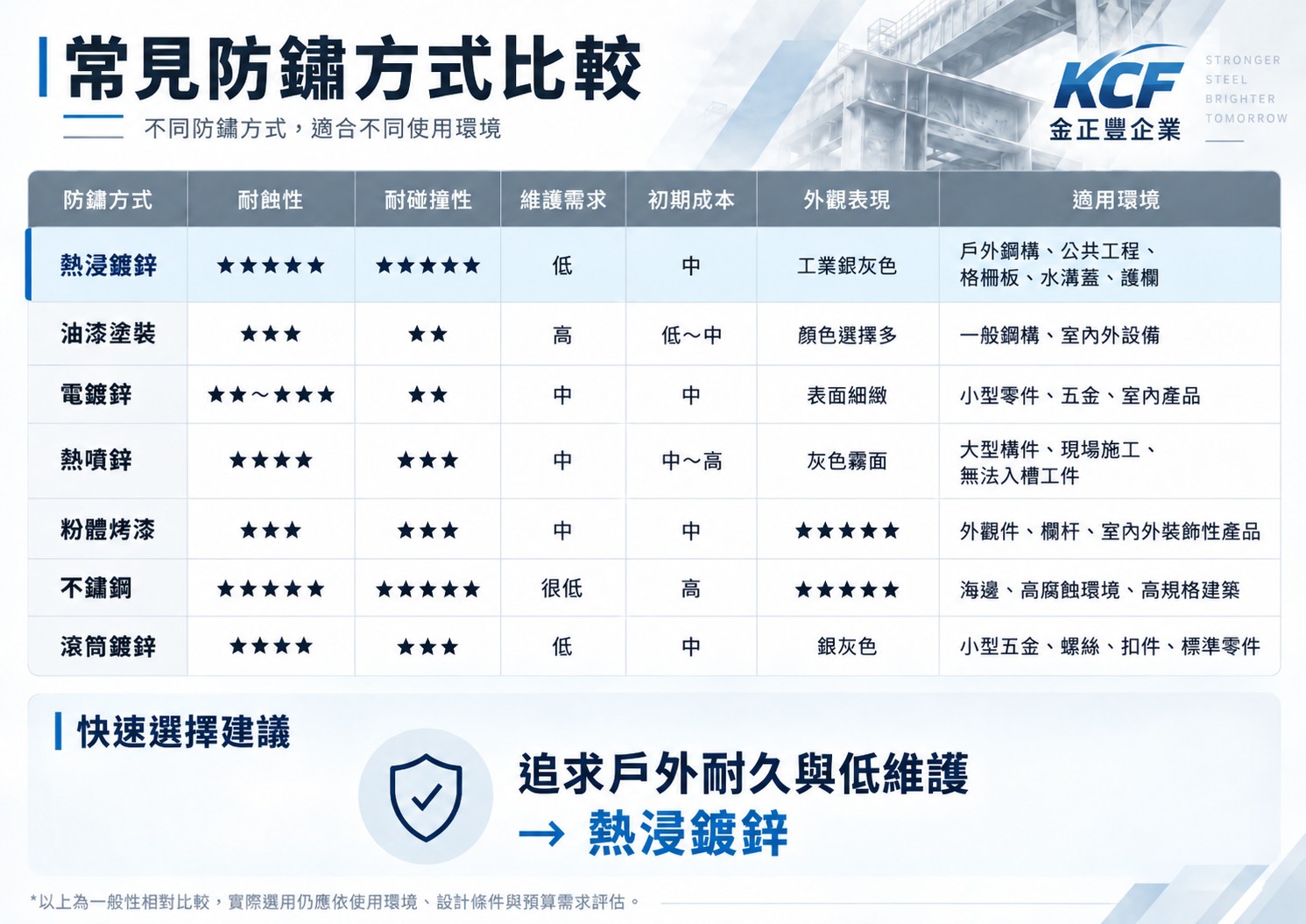
What Is the Difference Between Hot-Dip Galvanizing, Paint and Electroplating?
The following compares general technical characteristics. Actual performance is still affected by materials, treatment specifications, environmental conditions, workmanship and subsequent maintenance.
| Comparison Item | Paint / Coating | Electroplating | Hot-Dip Galvanizing |
|---|---|---|---|
| Main Principle | A paint film isolates the steel from the external environment | A metal coating is formed electrochemically | Zinc reacts with steel to form zinc-iron alloy layers and an outer zinc layer |
| Coating Characteristics | Varies with the coating system, application method and film thickness | Varies with the plating metal and process specifications | Metallurgically bonded to the steel substrate, forming zinc-iron alloy layers and a zinc layer |
| Appearance Options | Different colors and finishes available depending on the coating system | Different appearances depending on the plating type and post-treatment | Mainly the natural appearance of zinc, which may be bright silver, matte gray or vary in tone |
| Outdoor Engineering Applications | A suitable anti-corrosion coating system can be selected for the environment | Evaluated based on coating type, workpiece and environmental conditions | Commonly used for outdoor steel structures, grating, drain covers and engineering steel products |
| Subsequent Maintenance | Touch-up or repainting must be scheduled according to film deterioration, damage and environmental conditions | Evaluated based on coating wear, corrosion and actual service conditions | Suitable where the need for frequent rust removal and repainting should be reduced |
| Common Considerations | Color, appearance, on-site application and future repairs | Part size, appearance, plating type and functional requirements | Corrosion protection, outdoor use, workpiece structure, pre-galvanizing design and long-term maintenance |
※ The table above compares the general characteristics of different corrosion protection methods and is not a guarantee of fixed performance or service life. Actual performance should be evaluated based on materials, process specifications, environmental conditions, workmanship and maintenance.
Hot-dip galvanizing protection is
more than a surface barrier
Hot-dip galvanizing protects steel mainly through coating coverage and the electrochemical properties of zinc itself.
Barrier Protection
A complete zinc coating covers the steel surface, creating a barrier between the steel and the external environment and reducing the chance of moisture and corrosive media contacting the steel directly.
Sacrificial Protection
Zinc and iron have different electrochemical properties. Under certain conditions, zinc reacts preferentially, providing further corrosion protection for the steel substrate.
It's not just about "will it rust" —
subsequent maintenance costs matter too
If rust prevention methods are evaluated only by the initial application price, it is easy to overlook the repair and management costs incurred over many years of use.
When evaluating steel corrosion protection methods, we recommend considering the service environment, expected service period, subsequent inspection and touch-up, repair work, downtime caused by repairs, and material replacement.
A lower initial price does not necessarily mean a lower cost over the entire service life.
Some rust prevention systems may require periodic inspection, rust removal, repair or reapplication during use. For bridges, public facilities, factory steel structures, grating, drain covers and other products where lower maintenance frequency is desired or future repairs are difficult, factoring long-term maintenance into the choice of corrosion protection at the design stage gives a more complete picture.
Which Products Commonly Use Hot-Dip Galvanizing?
Hot-dip galvanizing is commonly used for outdoor, engineering and other steel products requiring corrosion protection. Whether it is suitable should still be confirmed based on the workpiece material, size, structure and service environment.
How to Choose a Rust Prevention Method?
Answer These 6 Questions First
Rather than directly comparing which rust prevention method is best, it is better to start from the product's own service conditions and then choose a corrosion protection system that meets the requirements.
Indoors, outdoors, humid environments or other special service conditions.
Corrosion protection planning should match the product's expected service period and engineering requirements.
For locations such as high places, bridges or large equipment, subsequent repair costs may be higher.
If a specific color or decorative finish is required, these surface requirements should be evaluated together.
Large, hollow and enclosed components require further confirmation of actual process conditions.
Compare initial treatment, repairs, touch-up, downtime and replacement costs together.
There is no absolute best rust prevention method —
the key is whether it suits the actual service conditions.
Paint, electroplating and hot-dip galvanizing each have their own suitable products and use cases. If a product needs a specific color or on-site repairs later, coating systems have their value; for specific parts and surface function requirements, a suitable electroplating treatment may be used.
Foroutdoor steel structures, grating, drain covers, public works and steel products where lower subsequent maintenance frequency is desired, it is worth further evaluating whether hot-dip galvanizing meets the product's corrosion protection and life-cycle requirements.
Hot-Dip Galvanizing & Steel Rust Prevention FAQ
Q1. Which is better, hot-dip galvanizing or paint?
The two methods suit different service conditions. Coatings can provide different colors and surface effects as needed and can be repaired according to the protection system; hot-dip galvanizing is commonly used for outdoor steel structures and steel products where less frequent maintenance is desired. The actual choice should be based on the service environment, appearance requirements, engineering specifications and maintenance approach.
Q2. What is the difference between electroplating and hot-dip galvanizing?
Electroplating mainly deposits metal on the workpiece surface electrochemically; hot-dip galvanizing immerses pre-treated steel in molten zinc so that the zinc reacts with the steel to form zinc-iron alloy layers and a zinc layer. The two differ in process, coating structure and common applications, and should be chosen according to product requirements.
Q3. Must outdoor steel structures be hot-dip galvanized?
Not necessarily. Outdoor steel structures can use different corrosion protection systems depending on engineering requirements. Hot-dip galvanizing is one of the common choices and is especially worth including when evaluating protection schemes intended to reduce subsequent maintenance frequency. The final decision should still be based on the environment, product structure, service requirements and specified standards.
Q4. How long does hot-dip galvanizing last?
There is no single fixed lifespan that applies to all hot-dip galvanized products. The actual protection period is affected by coating thickness, service environment, exposure conditions, pollution levels and subsequent maintenance. If a project has specific service-life requirements, it should be further evaluated based on the environment and specified standards.
Q5. Does hot-dip galvanizing require no maintenance at all?
No. Any engineering material should be properly inspected and maintained according to its service environment. One advantage of hot-dip galvanizing is that it can reduce the need for frequent rust removal and repainting of some steel products, but periodic checks should still be made based on the actual environment and coating condition.
Q6. Is a thicker hot-dip galvanized coating always better?
Thicker is not simply better. Coating thickness should be confirmed according to the product type, steel thickness, service conditions and the applicable hot-dip galvanizing standard. Quality assessment must also consider coverage, adhesion and other acceptance requirements.
Protect early,
and maintenance becomes easier.
Steel rust prevention should not be judged only by the initial application price, but evaluated comprehensively based onthe service environment, product design, expected service period and subsequent maintenance .
For steel structures and engineering products that are exposed outdoors or to humid environments for long periods, or that will be difficult to repair in the future, choosing a suitable corrosion protection method at the design stage is often far more worthwhile than repeated rust removal and repairs after the product has corroded.
This article provides general reference information on steel corrosion protection methods and hot-dip galvanizing. Actual protection methods, processes, coating requirements and performance should be evaluated based on product material, workpiece structure, service environment, engineering drawings and specified standards.