


Table of Contents
CONTENTS · 7 Chapters / 15 Design Points1. Hot-Dip Galvanizing Basics
The purpose of hot-dip galvanizing is to form a complete, protective zinc layer on the steel surface, isolating the steel from air and moisture, effectively slowing corrosion and extending product life. Once formed, even if the coating is locally scratched, zinc still provides sacrificial anode protection and continues to protect the steel, making it one of the most widely used steel corrosion protection technologies today.
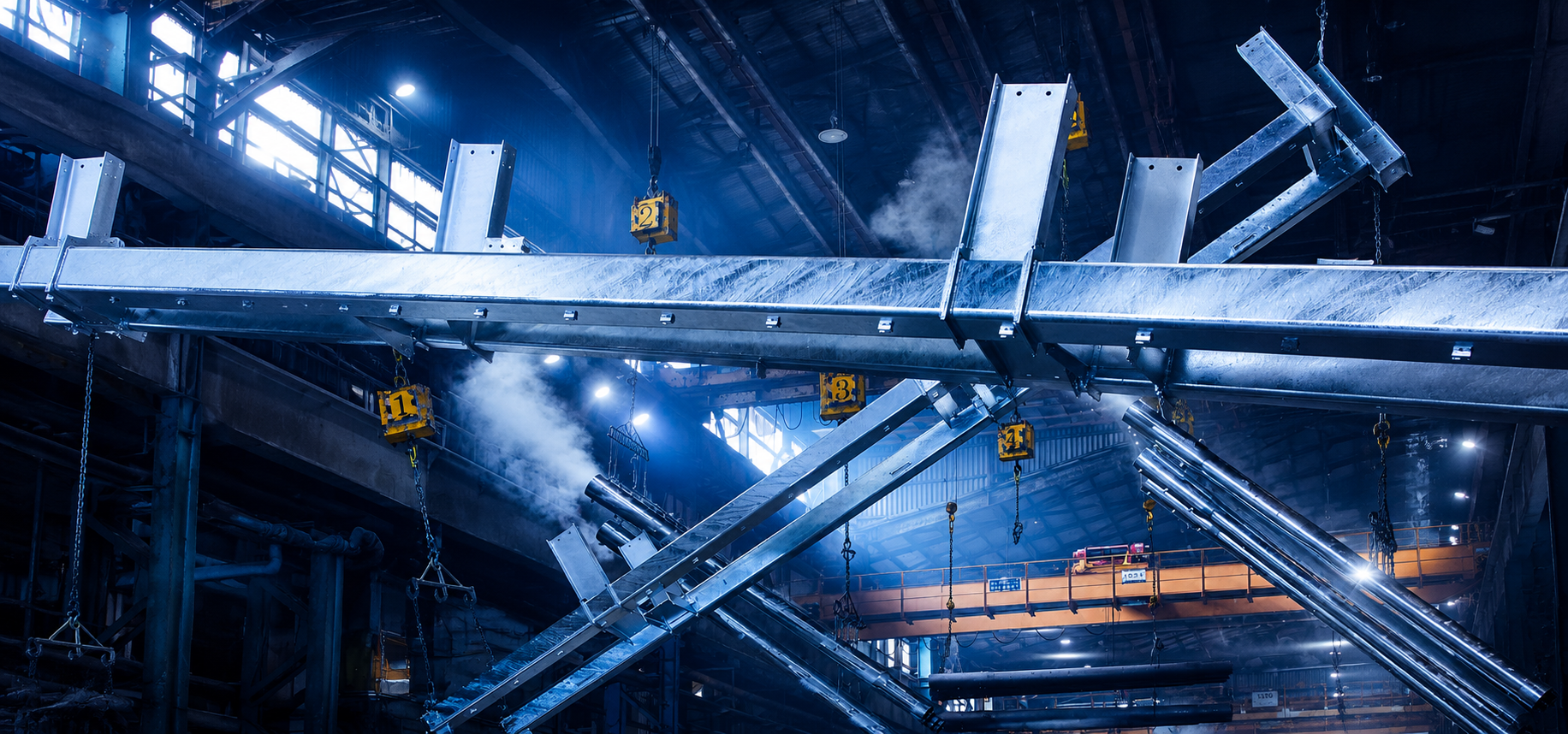
However, hot-dip galvanizing is not simply a matter of sending products into the zinc kettle. If the product design does not meet galvanizing process requirements, problems such as zinc accumulation, bare spots, distortion, poor venting or safety issues may still occur. Hot-dip galvanizing requirements should therefore be considered at the product design stage.
1. Gray (Dark) Coating Phenomenon
After hot-dip galvanizing, some product surfaces appear gray-black, commonly called "gray coating" or "dark coating." This mainly occurs when the steel has a high silicon (Si) content or when thick plates are used: the slower cooling rate allows zinc and steel to keep reacting metallurgically, so the iron-zinc alloy layer extends to the surface.
Gray coating is a normal metallurgical reaction and does not indicate poor galvanizing quality; it usually does not affect corrosion resistance, but differences in color may affect product consistency. If appearance requirements are high, we recommend evaluating this in advance during material selection and product design.
Design Points
- Steel with Si content of about 0.04–0.16% or above 0.23% is more likely to develop a gray coating.
- Thick plate products cool more slowly and are more likely to form a gray-black coating.
- Gray coating is a normal metallurgical reaction and does not indicate poor galvanizing quality.
- We recommend considering material characteristics and galvanizing requirements at the early design stage.
2. Hanging Design
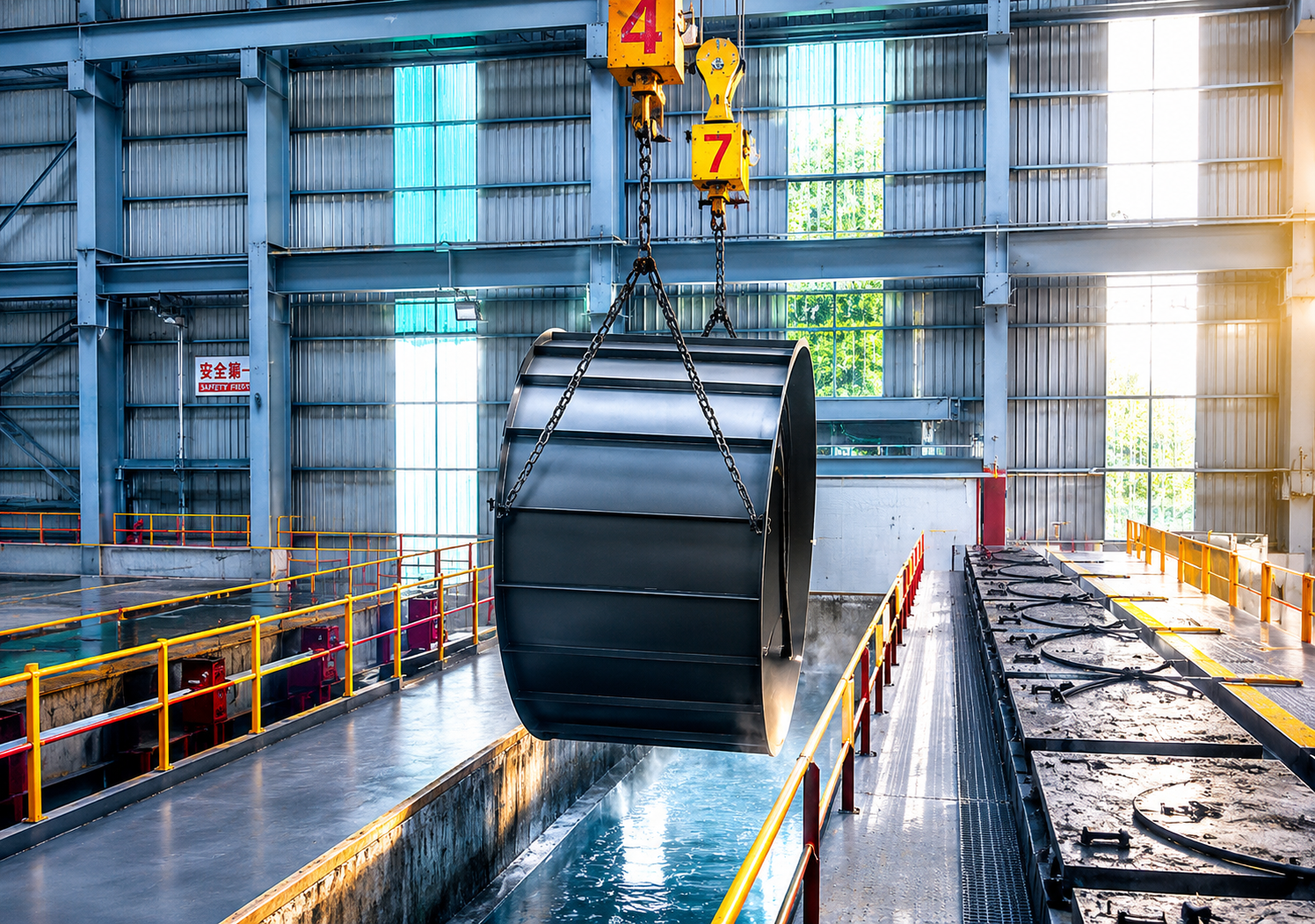
The hanging method is a very important part of hot-dip galvanizing. Products must be hung in the kettle so that molten zinc can flow in and out smoothly. Improperly designed hanging points can easily cause zinc accumulation, bare spots, uneven coating thickness or even product distortion. Product design should therefore consider the center of gravity, zinc drainage direction and ease of handling.
2. Hanging Methods for General Products
For general steel products, we recommend providing suitable hanging holes at both ends so that lifting gear can hold the product securely while allowing for the zinc drainage direction, letting molten zinc flow naturally. For heavier products, the hanging hole size should be increased appropriately; if holes cannot be made due to the product design, lifting lugs can be used instead.
Design Points
- Provide hanging holes of Ø12-15mm or larger at both ends of the product.
- Increase the hanging hole size for heavier products.
- Install lifting lugs where holes cannot be made.
- Hanging positions should take into account the product's center of gravity and zinc drainage direction.
3. Hanging Methods for Checkered Plate & Trench Cover Products
Products such as checkered steel plates, platform plates and trench covers usually have angle steel or handles welded on the back. Hanging directly by the handles can easily cause unbalanced hanging, affecting zinc flow and resulting in uneven coating thickness or local zinc accumulation. We therefore recommend providing hanging holes at both ends of the angle steel as the designated hanging points.
When a product is longer than two meters or relatively heavy, two-point hanging is recommended to improve operational safety and reduce the risk of distortion.
Design Points
- Hanging directly by the handles is not recommended.
- Provide hanging holes of Ø12-15mm or larger at both ends of the angle steel.
- Two-point hanging is recommended for lengths over 2 meters.
- Hanging hole size can be enlarged as weight increases.
- Venting, zinc drainage and operational safety should all be considered in the design.
3. Masking & Thread Protection
In some products, certain areas are unsuitable for hot-dip galvanizing because of subsequent machining, assembly or dimensional fit requirements, such as threads, mating surfaces and machined surfaces. If masking is not completed before galvanizing, it can easily cause assembly difficulties, dimensional errors or additional post-processing costs. Masking design is therefore an important part of the hot-dip galvanizing process that cannot be overlooked.
4. Masking (Non-Galvanized) Treatment
When part of a product does not need galvanizing, masking should be completed before the product is sent for galvanizing. Before application, oil and impurities on the surface should be thoroughly removed, then a masking compound applied evenly. Once the coating is completely dry, protect it with cloth tape to prevent it from peeling off during pre-treatment and compromising the masking effect.
Good masking not only ensures that no zinc adheres to designated areas, but also reduces the time required for subsequent finishing, improving overall efficiency.
Design Points
- Complete all masking work before sending for galvanizing.
- Remove oil and impurities from the surface before application.
- Apply masking compound evenly and allow it to dry completely.
- Cloth tape is recommended to protect masked areas.
- Do not stack products before the compound is dry, to avoid peeling of the coating.
5. Masking of Threaded Areas
Threads require high dimensional precision. If galvanized directly, the added coating thickness can easily affect thread fit. We therefore recommend completing thread masking before galvanizing to ensure smooth subsequent assembly.
External threads can be coated with masking compound and wrapped with cloth tape once dry; internal threads can be fitted with bolts and thread seal tape, or sealed with a heat-resistant filler, to prevent molten zinc from entering the threads.
Design Points
- Apply masking compound to external threads.
- Protect with cloth tape once the compound is dry.
- Fit bolts with thread seal tape into internal threads.
- Heat-resistant fillers can also be used for protection.
- Confirm the masking compound is completely dry before sending for galvanizing.
4. Vent Hole & Opening Design
During hot-dip galvanizing, molten zinc must fully flow into the component and then drain out smoothly, so all enclosed structures must have appropriate vent holes and zinc drain holes. Without complete planning, this can easily cause bare spots, zinc accumulation and poor coating quality, and pressure built up in enclosed spaces may even compromise operational safety.
6. Hole Design for Square Tubes & Box Columns
For square tubes, box columns and enclosed frame products, we recommend placing vent holes at all four corners so that air and molten zinc can flow freely. For larger products, a central zinc drain hole can be added to improve zinc flow efficiency.
Welded areas should also retain suitable openings to avoid forming fully enclosed spaces that affect galvanizing quality.
Design Points
- Vent holes should be provided at all four corners.
- Total hole area is recommended to be at least 20% of the cross-sectional area.
- Large components can have an additional central zinc drain hole.
- Maintain suitable openings at welds.
- Avoid forming fully enclosed spaces.
7. Vent Hole Design for Handrails & Pipes
Handrails and pipes are mostly enclosed tubular structures. Without vent holes, air, moisture and molten zinc cannot flow normally, which can easily cause local bare spots and even increase operational risk. Before galvanizing, confirm that vent holes have been designed for all pipes.
Vent holes are usually placed at bends, corners, sleeve roots and both open ends to ensure smooth zinc flow.
Design Points
- Keep pipe ends open.
- Vent holes must be provided at all bends and corners.
- A hole diameter of Ø10mm or larger is recommended.
- Keep the interior connected as much as possible when welding.
- Avoid forming enclosed cavities.
8. Vent Hole Design for Pipe Ladders
Pipe ladders and large tubular components are usually made of multiple round pipes welded together. If enclosed spaces form inside, air expanding under heat during hot-dip galvanizing can be dangerous, so vent hole design is especially important.
We recommend vent holes at both ends, at radiused corners and at all corners. Confirm again before galvanizing that all holes are complete to ensure processing safety and coating quality.
Design Points
- Keep pipe ends open.
- Vent holes should be provided at radiused corners and all corners.
- A hole diameter of Ø10mm or larger is recommended.
- Check all vent holes again before sending for galvanizing.
- Avoid enclosed spaces that create processing hazards.
9. Scallop Hole Design
In enclosed stands, frames and welded section steel products, air pockets easily form at weld junctions. We therefore recommend scallop holes or corner cuts so that molten zinc and air can flow freely, improving galvanizing completeness.
Besides aiding venting and zinc drainage, scallop holes also reduce the likelihood of bare spots and corrosion, making them a very important detail in steel structure design.
Design Points
- Corner cuts are recommended at weld intersections.
- Leave venting space at all four corners.
- Avoid forming enclosed structures.
- Improve zinc flow efficiency.
- Reduce the risk of bare spots and zinc accumulation.
5. Structural Design Precautions
Besides affecting overall strength and construction methods, a product's structural design also directly affects hot-dip galvanizing quality. Improper design can easily cause zinc accumulation, bare spots, thermal distortion and rust weeping, so we recommend taking the galvanizing process into account at the product design stage to improve processing quality and durability.
10. Overlapping (Lap) Structure Design
When two steel plates or sections are welded together face to face, narrow gaps inside can easily leave ungalvanized areas after hot-dip galvanizing. When moisture penetrates these gaps, rust weeping can occur, affecting product appearance and durability.
We recommend avoiding lap structures in product design wherever possible. Use separate-part designs or all-around welding, add plug welds when necessary, and leave space for zinc flow to reduce later corrosion risk.
Design Points
- Prefer separate-part designs.
- Avoid narrow overlapping spaces.
- Use all-around welding to reduce water ingress.
- Add plug welds where necessary.
- Leave space for zinc flow.
11. Non-Scallop Method / Weld Access Hole-Free Method
In recent years, steel structure designs have often used the non-scallop or weld access hole-free method, which improves structural integrity and durability, but after hot-dip galvanizing, local zinc accumulation easily forms.
Zinc accumulation is a normal processing phenomenon and usually does not affect coating quality, so forcible removal by hammering is not recommended, as it may damage the integrity of the zinc layer.
Design Points
- Zinc drain hole size and position should comply with design specifications.
- Local zinc accumulation is a normal processing phenomenon.
- Avoid removing zinc accumulation by hammering.
- Plan the zinc drainage direction according to product requirements.
12. Thermal Distortion Countermeasures for Stair Platforms
Stair platforms, checkered steel plates and large platform products have large heated areas and are more prone to thermal distortion from high temperatures during hot-dip galvanizing. Reinforcement should therefore be added appropriately in the design to increase product rigidity.
Adding flat bar stiffeners on the back, grid-pattern reinforcement or increasing the checkered plate thickness can effectively reduce distortion and improve construction quality.
Design Points
- A checkered plate thickness of 6mm or more is recommended.
- Stiffener flat bar spacing of 400mm or less is recommended.
- Leave suitable gaps at stiffener intersections.
- Large platforms can have grid-pattern reinforcement.
- Reduce the likelihood of thermal distortion.
6. Product Marking & Metal Tag Attachment
Products usually need identification marking before galvanizing to facilitate production, management and shipping identification. However, improper marking may cause local bare spots, incomplete coating or affect product appearance, so we recommend marking methods compatible with the hot-dip galvanizing process.
13. Notes on Using Marker Pens
We recommend marking products to be galvanized with water-based markers. Some oil-based inks cannot be completely removed during pre-treatment and may affect pickling, preventing zinc from adhering properly in local areas and causing bare spots.
Design Points
- Prefer water-based markers.
- Avoid using oil-based pens over large areas.
- If oil-based pens are used, confirm suitability for the product.
- Avoid affecting galvanizing adhesion quality.
14. Metal Tag Attachment
Product identification tags must not be attached directly to the workpiece surface, to avoid bare spots at the contact area or blocking zinc flow. We recommend fixing tags with iron wire so that they are kept at a suitable distance from the workpiece, ensuring a complete coating.
Design Points
- Fix with iron wire of 1.2mm or thicker.
- Keep a suitable distance between the tag and the workpiece.
- Avoid attaching at contact points with lifting gear.
15. Tag Attachment for Handrail Products
For handrail products, we recommend attaching identification tags near the joint at the ground end, rather than on the main visible surfaces or posts, to reduce the chance of scratches or bare spots during hanging while maintaining product appearance.
Design Points
- Fix with iron wire of 1.2mm or thicker.
- Avoid attaching to the top rail of the handrail.
- Avoid attaching to the visible surface of posts.
- Keep a suitable distance between the tag and the product.
7. Design Recommendations Summary
Hot-dip galvanizing is a mature corrosion protection technology widely applied to all kinds of steel products, but galvanizing quality depends not only on the process but also closely on the product design itself. Considering hanging methods, masking needs, venting and zinc drainage, hole layout and structural form at the early design stage not only improves coating quality but also reduces rework, shortens processing time and extends product life.
With many years of hot-dip galvanizing experience, K.C.F. Enterprise can provide professional design advice for different product types, helping customers plan galvanizing requirements in advance during product development to create steel products that combine quality, safety and durability.
FAQ
Q1: Does a gray (dark) coating mean galvanizing has failed?
No. Gray coating is a normal metallurgical reaction; it usually does not affect corrosion resistance and only affects surface appearance.
Q2: Must products have hanging holes?
Hanging holes or lifting lugs are recommended. They improve hanging stability while also aiding zinc drainage and reducing product distortion.
Q3: Why must square tubes have vent holes?
Vent holes allow air and molten zinc to flow freely and prevent enclosed spaces, improving galvanizing quality and operational safety.
Q4: Which areas need masking?
Threads, machined surfaces, mating surfaces and special functional areas are usually recommended to be masked before galvanizing.
Q5: Will products always distort after hot-dip galvanizing?
Not all products distort, but large platforms, checkered steel plates and thin sheet components are more easily affected by high temperatures, so appropriate reinforcement in the design is recommended.
Q6: Does zinc accumulation need to be knocked off?
Local zinc accumulation is a normal processing phenomenon. Removing it by hammering is not recommended, as it may damage the coating.
Q7: Can oil-based pens be used to mark products?
Water-based markers are recommended to prevent oil-based ink from affecting galvanizing adhesion quality.
Q8: Should hot-dip galvanizing be considered at the product design stage?
Including hot-dip galvanizing requirements at the early design stage is recommended; it effectively improves coating quality, reduces rework costs and increases processing efficiency.
Professional Hot-Dip Galvanizing Services
K.C.F. Enterprise has many years of experience in hot-dip galvanizing, providing galvanizing services for all kinds of steel structures, building components, public works facilities and customized metal products. Beyond a complete processing workflow, we can also offer professional advice at the product design stage, from hanging methods, vent hole layout and masking planning to structural design, comprehensively improving product quality and processing efficiency.
If you have any questions about hot-dip galvanizing design or processing, please contact K.C.F. Enterprise. We will provide the professional advice and service best suited to your needs.
Back to Design Guide ↑